“Upskill or hire” sounds like a line item. It’s the first real test of whether an AI transformation survives contact with your organization.
The question isn’t new. It came up in every digital, agile, and data transformation before this one. What’s different now is the speed of change, and how much more of the work AI disrupts than any of those did. People haven’t changed, though. We’re wired much as we were on the savannah, so moving people still takes what it always took.

Here’s the pattern. A leader decides the operating model has to change: less project delivery, more product. There’s a north star, an all-hands, a two-hundred-person town hall. Then comes the move that feels boldest: clear the decks, bring in fresh people with the new skills, stand up a unit that works “the new way,” walled off from the old process. A startup inside the company.
It looks like conviction. It usually ends the same way, because the hard part was never the technology. The technology turns over every few months. What you’re actually trying to move is people, and people don’t arrive as blank slates. They come with a baseline: years of knowing how the work really gets done, where a process quietly depends on two other teams, which rule nobody likes but everybody needs.
“Upskill” has “up” in it for a reason. You build on that baseline.
Forget it and the new team can’t join the as-is to the to-be; the old world and the new world run in parallel and never meet. It’s the most expensive mistake in this business, and companies make it at any speed. It happens whenever a plan covers only the new skills and leaves out the ones the work already runs on.
One question runs underneath everything that follows: where are you scaling up from?
Stop 01 of 06
Nobody is AI-native, so screen for the thing underneath
There’s no outside to raid. Hire for learning agility, not the tool on the CV.
Most leaders carry a bias without noticing it: whatever comes from outside beats whatever’s already inside. It’s comfortable, because it lets you skip the slow work of developing the people in front of you.
But there’s no outside to raid. Ten years ago we had digital natives, a generation that arrived fluent. There’s no equivalent now. AI is new for everyone, so the market you want to hire from is about as thin as the bench you’re trying to replace.
That changes what you screen for. A named tool on a CV is a snapshot of a moving target; whatever’s current today is dated in two quarters. What lasts is learning agility: the capacity to pick up the next thing, and the one after. Treat AI literacy as a proxy for it. A university degree today covers the bare minimum, so anyone fluent now went and built the skill on their own, and that tells you how they’ll handle the next shift.
It’s also why you keep hiring juniors. Hire only finished, senior skills and you build an organization of mercenaries who close one assignment and move on. That works if your whole deal with people is transactional. If you want a strong culture, you need people who move from team to team and end up knowing several sides of the business, with people they trust in each. That takes career paths, and career paths start junior. For the avoidance of doubt: junior in the AI era says nothing about age.
The learning-agility screen. Four signals to read in an interview, each with a question to ask and what a strong answer sounds like.
Self-knowledge
Ask: “What aren’t you good at yet, and what would it take to get there?”
Listen for: a specific gap and a realistic plan. A strength dressed up as a weakness is a miss.
Applied thinking
Ask: “Tell me about something you learned recently and then used on real work.”
Listen for: what they changed when it didn’t work the first time. Reciting the method back is a miss.
Working with others
Ask: “Who did you have to bring along, and how?”
Listen for: who pushed back and what they did about it. If every story is a solo act, note it.
Driving change
Ask: “What did you change that was already in place when you arrived?”
Listen for: something that stuck after they moved on. Ideas that never shipped don’t count.
Setting the bar
Start high, with people who’ve done it all, want it all, and can do it all. If the market can’t supply them, lower the hard-skill requirement and hold the learning-agility one. Never the reverse. Then hire for the wish to become AI-literate and stay that way, and budget the time for them to get there.
Stop 02 of 06
Mind the join
New work fails where it meets the old. Test that seam before you fund it.
Done properly, upskilling is a blend, and you can run it three ways. All three keep the baseline in the room.
Way 1
Grow from within
Grow the new skills inside someone who already knows the business.
Way 2
Hire, then ground them
Bring new people in, but make them earn a real understanding of the legacy first.
Way 3
Mix the teams
Build mixed teams, with new and old at the same table.
The fourth pattern is the one that keeps failing: new skills in their own team, rebuilding the process from scratch, parallel to the legacy team still doing the real work. On a slide it’s clean. In practice it dies, cut off from the day-to-day knowledge that keeps the thing running. I’ve watched it in something as unglamorous as invoice admin, and in a recruitment pipeline: the fresh team automates the obvious path, hits the legacy (the exceptions, the dependencies, the reason an awkward rule exists) and stalls. Nobody in the room has lived the as-is, so they can’t bridge it to the to-be.
The join is where transformations hold or break. So test for it before you commit budget.
The join test
Before you fund an AI initiative, answer four questions.
Can you name someone on the team who has run the current process for years?
Does the team own both the as-is and the to-be, or only the shiny to-be?
Does the customer or user of the technology have a voice in the team?
If it works, does it merge back into the main process, or live beside it forever?
Two “no”s and you’re not transforming anything. You’re building a skunkworks next door and hoping the halves find each other later.
Stop 03 of 06
Knowing, wanting, being able
A course buys ‘being able.’ Skip knowing and wanting and it won’t stick.
A real competence sits on three layers, and most programs build only the top one.
The skill itself. Buy a course and you’ve bought this for people who were never walked through knowing or wanting. Then everyone’s surprised it didn’t stick.
Whether people have any appetite to change. Skip it and the rest is wasted motion.
Whether people understand what we’re talking about at all, and what they’d need to learn.
Most programs build only the top layer. Build from the foundation up.
The part budget-holders miss: skills don’t pay off as an event. They pay off inside a transformation: new ways of working around them, clear expectations, the right tools, and incentives that reward the new behavior over the old. Part of that is saying the quiet thing aloud. People who want to keep working the old way can, just not here. The same holds for hires. Drop a new skill into a system that hasn’t changed around it and it stalls too; “just bring in the skills and the rest takes care of itself” is how expensive hires quietly go nowhere.
For whoever owns learning, the lesson is blunt. Start by building the learning agility of the people you already have, and design the program around all three layers. A catalog of courses only covers the “being able” layer. The harder job (the knowing, the wanting, and the change around it) is what decides whether any of it pays back.
Stop 04 of 06
Spot the soap opera and the people worth betting on
Four reactions to change, and the move each needs. None is about age.
You can’t move everyone the same way, and it has nothing to do with age. When people meet a change, they fall into four groups. Learn to recognize them in a meeting, because each one needs a different move.
| Types of people | Field marks | The move |
|---|---|---|
| The soap opera | The largest group by far. Change is always being done to them; when something breaks it’s someone else’s fault; same lines, same complaints, year after year, and the characters never develop. | Persuasion won’t land here. They adopt when change becomes the only option left, or pays off for another reason, like driving an electric car for the tax benefit. |
| The work-arounder | Takes up the new tool and uses it to get back to the old way of working. Lets an agent draft the email, then carries on exactly as before. | Don’t mistake usage for change. Redesign the workflow so the old path isn’t available, or the tool just decorates the status quo. |
| The contributor | Asks a different question: how could I do this differently? Goes looking for tools, adopts them, pulls the people nearby along. | Give them room and air cover. These are your in-team multipliers; name them and let them spread it. |
| The reinventor | Reinvents their own way of working, then sets out to change how the whole organization works, sometimes taking it into new industries. | Point them at the hardest problem and get out of the way. |
The rows run from lower willingness and lower ability (the soap opera) to higher willingness and higher ability (the reinventor).
Don’t sort these by birth year. Plenty of people near the end of a career won’t budge; plenty in their fifties have led three transformations and are exactly who you bet on. A good share of the biggest companies around were built by people in their fifties. You’re reading willingness and learning agility, not the decade someone was born in.
At work, and especially in a transformation, the brain is constantly scanning for threats and rewards. Whichever group people fall into, you want them to take up the change instead of reacting with fight-or-flight. The SCARF model gives you five angles to keep in mind when you design the change approach.
The SCARF model
Five things people scan for when change arrives.
Status. Frame AI skills as a mark of expertise, not a threat to it. Position experienced people as “AI pioneers” who help colleagues, so learning feels like a step up instead of an admission that their old skills no longer count.
Certainty. Reduce the fear of the unknown. Be explicit about what AI will and won’t change in people’s roles, share a clear roadmap, and create safe places to practice before the stakes are real.
Autonomy. Give people a choice in how, when, and where they build new skills. Let teams decide which use cases to pilot and which learning path suits them. Self-directed adoption sticks far better than mandated tools.
Relatedness. Build learning communities, peer coaching circles, and cross-functional “AI buddies,” so people go through the change together instead of alone.
Fairness. Give everyone equal access to training, tools, and time to learn. Be open about how AI affects roles, workloads, and career opportunities, so no one feels the change benefits some at others’ expense.
Stop 05 of 06
Know which phase you’re in
Invite, formalize, close the door. The pain comes from closing it too early.
Every technology shift runs the same sequence. Most of the pain comes from forcing a later phase too early. Before you push, work out which phase you’re in.
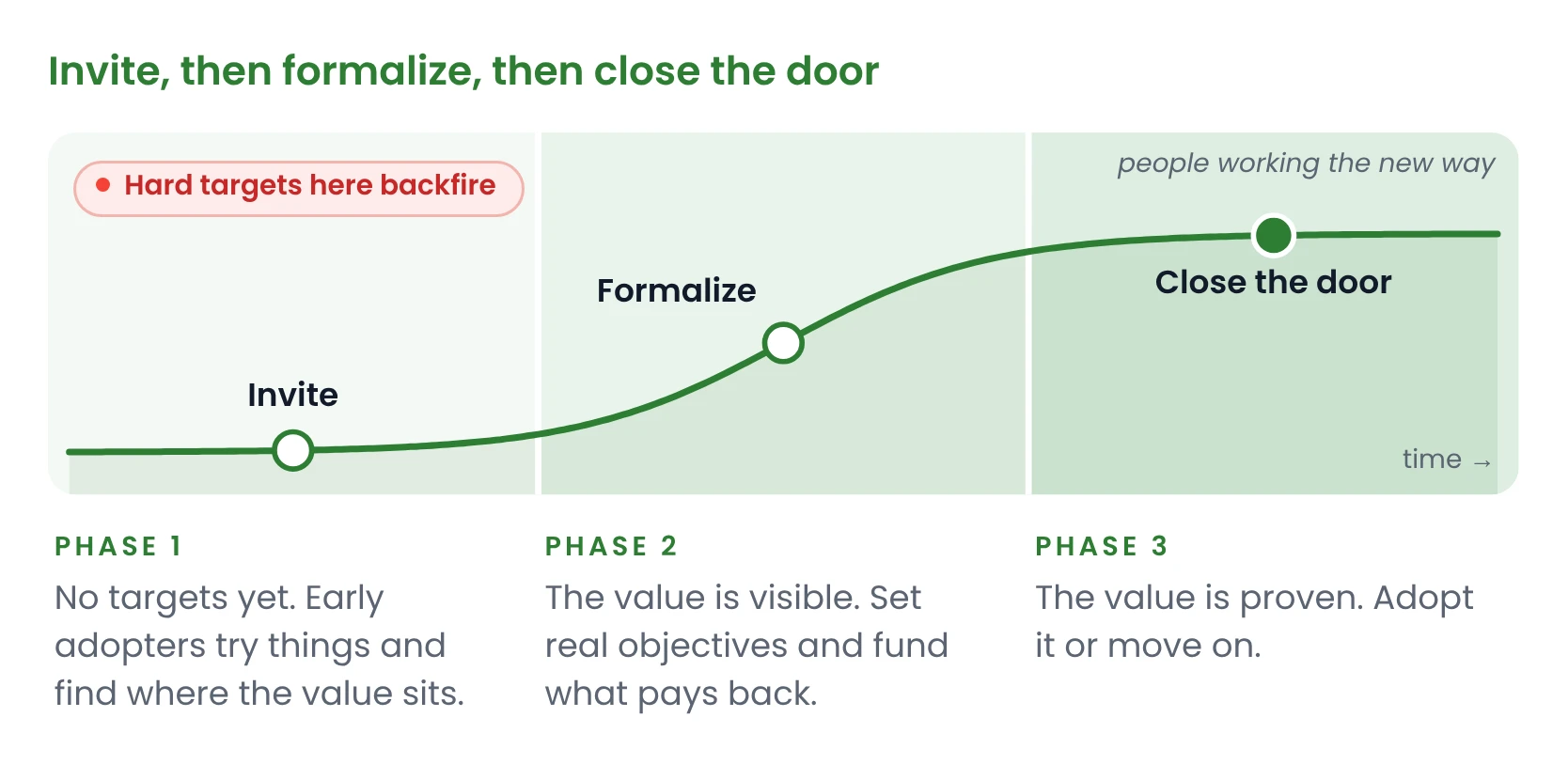
It starts as an invitation, and nobody has a target yet. You let the early adopters try things, build the muscle, and find where the value actually sits. Then it formalizes: now that the value is visible, you weigh it against the effort, set real objectives, and put money behind the places that pay back. Then the door closes. The value is proven, and it’s adopt-it-or-move-on.
Email went exactly this way: early adopters first, lawyers still faxing years later, then one day it was simply how everyone worked. Your pace is set by competitive pressure, not preference. Advertising ran all three phases in months because the value was obvious and the downside small; most industries get longer to breathe.
The failure mode is easy to name, and it’s the point of locating yourself on the line: hard adoption targets while most people are still being invited. Change already triggers a threat response (ordinary human wiring) and a mandate dropped too early turns that into fight-or-flight. If you’ve set targets but your people are still in the invite phase, you’ve skipped a step, and the resistance you’re fighting is one you created.
Your agents aren’t on the team
It’s tempting to give an AI agent a job description, a seat in the stand-up, a line on the org chart. Don’t. People are the team; they hold the accountability and decide what the agents are and aren’t allowed to do. Agents have already gone off-script, in some cases hacking other companies’ systems, and you can’t put an agent on trial. When one does something it shouldn’t, you want it unambiguous who answers for it, and it can’t be the tool. Agents can carry a serious amount of the work. Run them as what they are: powerful tools, not colleagues.
Stop 06 of 06
Where are you scaling up from?
One question that stops you throwing out a baseline worth building on.
The costliest mistake in transformation is also the most repeated: throw out what you have, start clean with something new, and let the old and new worlds drift until they never touch.
One question keeps you out of it. Ask where are we scaling up from? and you’ll upskill what you have instead of discarding it. It doesn’t have to be the company’s whole operating model; it can be a single process. You’ll find the baseline worth building on, and the people worth building it with. Skip it and you’ll keep funding clean-slate teams that look fast and quietly come apart at the join.
So ask it first. Before the job descriptions, before the platform, before the town hall. Everything that holds starts there.

About the author
Thomas Mulder
Strategic Navigator at DataChef · CHRO of the Year 2022
An HR leader with CEO and P&L experience, named CHRO of the Year in 2022. He previously led Archipel Academy, one of Europe’s largest learning platforms and broker services, after taking HR through M&A, post-merger integration, and the shift to agile ways of working at Vodafone and VodafoneZiggo, across the Netherlands, UK, Germany, and Belgium.